Peptide Reconstitution Calculator
A mathematical tool for calculating solution concentration (mg/mL) and draw volume (mL) when reconstituting a lyophilized (freeze-dried) compound. Enter the total vial amount, the volume of diluent added, and the desired mass to measure — this calculator performs the arithmetic and shows the step-by-step formula. It does not provide medical, clinical, or dosage guidance of any kind.
Important Disclaimer
- Educational and informational purposes only. This calculator is a mathematical tool. It is not medical advice, pharmaceutical guidance, or clinical instruction.
- No dosage recommendations. The "Desired Dose" field is a mathematical input representing a mass in milligrams. This calculator does not recommend, suggest, or endorse any specific amount of any compound for any use.
- No endorsement of any compound or product. We do not promote, recommend, or endorse the purchase, use, or administration of any substance, compound, or product.
- Arithmetic only. This tool performs two divisions: mass ÷ volume, and mass ÷ concentration. It has no knowledge of the specific substance being calculated.
- We do not sell or distribute any compounds. This website is a calculator resource only.
- Consult a licensed healthcare professional for any medical, pharmaceutical, or clinical guidance.
Understanding Reconstitution Math
What Is Reconstitution?
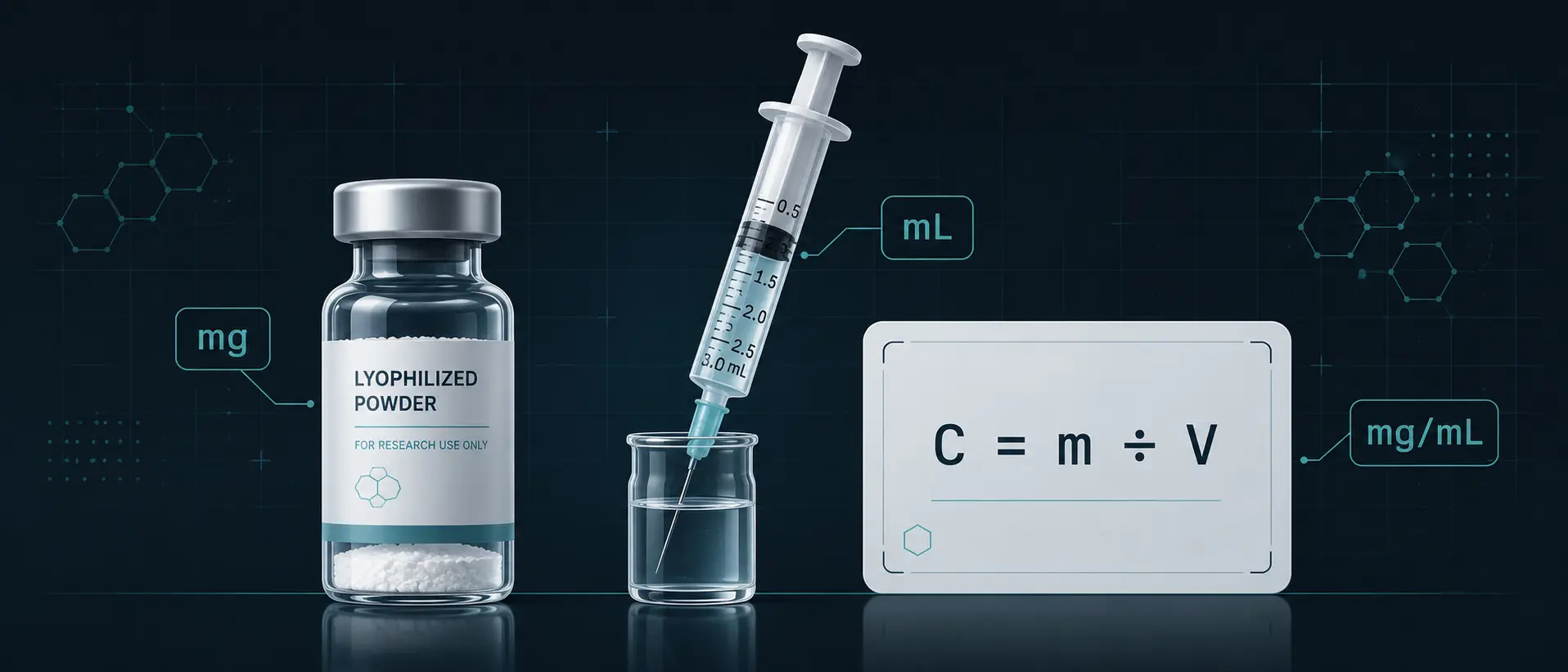
Reconstitution is the process of dissolving a lyophilized (freeze-dried) or powdered solid into a liquid to produce a solution. In laboratory and pharmaceutical settings, many compounds are stored as dry powder to improve stability and shelf life. When reconstituted, the compound is dissolved in a measured volume of liquid (the diluent). The two key calculations that follow are: determining the resulting concentration, and determining what volume of solution contains a specific mass of the compound.
What Is Concentration (mg/mL)?
Concentration expresses how much of a substance is present per unit of solution volume. When expressed as milligrams per milliliter (mg/mL), it answers: "How many milligrams of compound are in each milliliter of this solution?" This is a fundamental concept in chemistry. A higher concentration means more mass per unit volume; a lower concentration means less mass per unit volume. The relationship is linear — double the diluent volume and you halve the concentration.
The Two Formulas
Formula 1 — Concentration
Formula 2 — Volume to Draw
Both formulas are derived from the fundamental concentration equation C = m / V, where C is concentration, m is mass, and V is volume. Rearranging for V gives V = m / C, which is the Volume to Draw formula.
Worked Example
Suppose a vial contains 5 mg of compound and 2 mL of diluent is added:
- 1Concentration = 5 mg ÷ 2 mL = 2.5 mg/mL
- 2To measure out 0.5 mg: Volume = 0.5 mg ÷ 2.5 mg/mL = 0.2 mL
Frequently Asked Questions
1What formula is used to calculate reconstitution concentration?
Concentration (mg/mL) = Total Vial Amount (mg) ÷ Diluent Volume Added (mL). This is a direct application of the concentration equation C = m / V, where C is concentration, m is mass, and V is volume.
2How do I calculate the volume to draw for a specific mass?
Volume to Draw (mL) = Desired Mass (mg) ÷ Concentration (mg/mL). For example, if the concentration is 2.5 mg/mL and you need 0.5 mg, the volume to draw is 0.5 ÷ 2.5 = 0.2 mL.
3Why does adding more diluent reduce the concentration?
Concentration is mass divided by volume (C = m / V). Holding mass constant and increasing volume results in a mathematically lower concentration — the same amount of compound is distributed across more liquid.
4What unit is concentration expressed in and what does it mean?
Concentration is expressed in milligrams per milliliter (mg/mL). This means: for every 1 mL of solution you draw, that volume contains the stated number of milligrams of compound. It is a standard unit of mass-per-volume concentration used in chemistry and laboratory science.
5Can this calculator be used for any powdered compound that requires reconstitution?
Yes. The mathematical formulas for dilution and concentration are universal. They apply to any scenario involving dissolving a known mass of powder into a known volume of liquid. The calculator performs arithmetic only and has no knowledge of the specific compound involved.
6What if I want to use a different diluent volume than I previously calculated with?
Simply change the 'Diluent Volume Added' value and recalculate. The concentration and required draw volume will update automatically based on the new inputs. The amount of diluent used determines the concentration, which in turn determines the volume needed to measure out a given mass.
Powered by HumanCalculations — free online calculators