School psychology and IEP evaluations
Chronological age is often required when age-normed academic, cognitive, or developmental measures are interpreted against standardized tables.
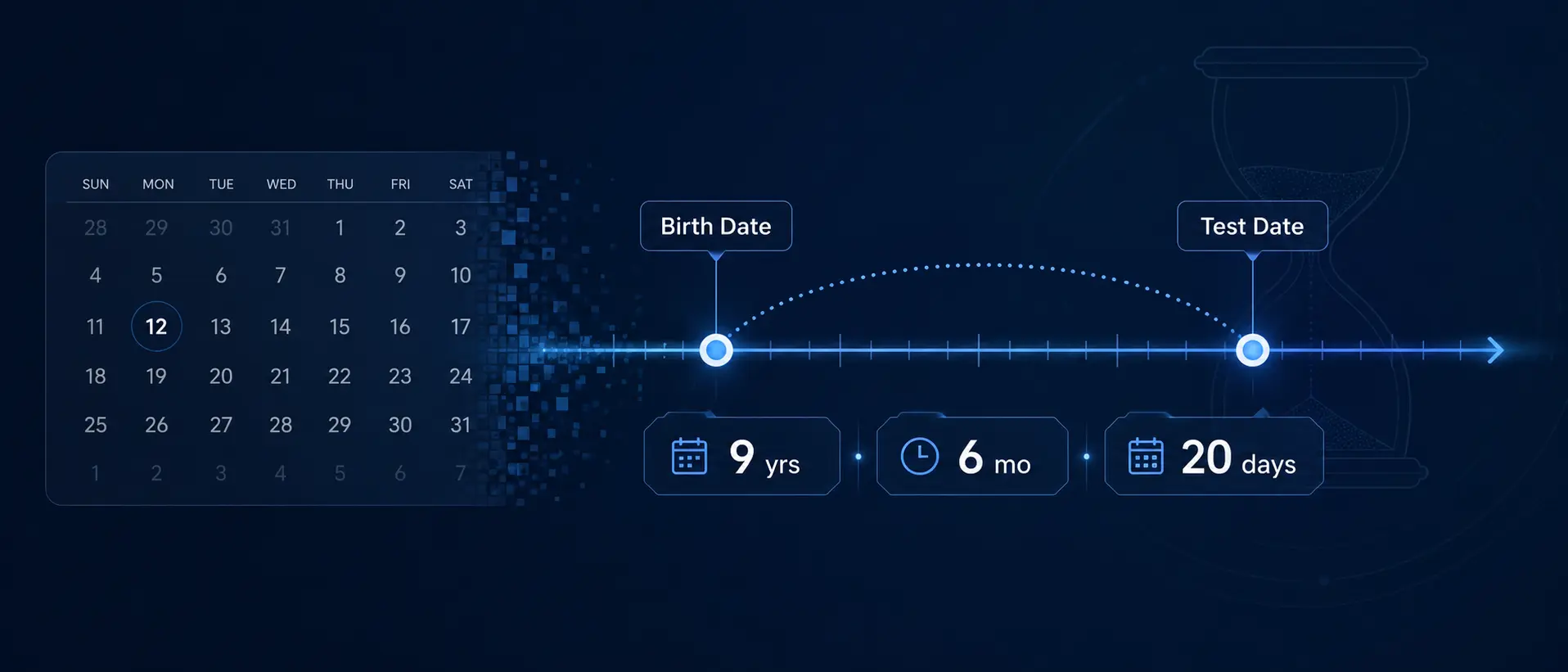
Calculate exact chronological age from a date of birth to a specific reference date. This is the format commonly needed for school testing, WISC scoring, developmental follow-up, medical documentation, research screening, and any report that needs more than a simple whole-year age.
Chronological age is the exact amount of time that has passed between a person's birth date and a chosen reference date. It is not an estimate, a rounded age, or a casual shorthand. It is a calendar-based calculation expressed precisely in years, months, and days.
That precision matters more often than people realize. In everyday conversation, saying someone is “8 years old” is usually enough. But in testing, medicine, education, and research, a person's exact age on the relevant date can change how norms are selected, thresholds are interpreted, and records are documented. In those settings, age on the reference date is what matters, not age as of today unless today is the actual date of service.
This calculator is designed for that exact use case. Enter a birth date, choose either today or a custom reference date, and it returns a full chronological-age breakdown. If you only need a quick present-day answer, our Age Calculator may be enough. If you need a future cutoff in whole years, try How Old Will I Be on…?.
Chronological age is often required when age-normed academic, cognitive, or developmental measures are interpreted against standardized tables.
Pediatric clinics and specialists often need an exact age on the visit date, not just the child's age in completed years.
Eligibility cutoffs are frequently based on age at consent, assessment, or enrollment, which makes the reference date just as important as the birth date.
Reports, multidisciplinary evaluations, and legal or insurance paperwork often need a precise age label tied to one exact calendar day.
The logic is simple in principle but easy to get wrong by hand. You start with the birth date, choose the exact reference date, and then calculate the elapsed time between those two dates. The calculator returns two kinds of output: the familiar breakdown in years, months, and days, plus the total time elapsed in days, weeks, and months.
The tricky part is borrowing across calendar months correctly. Months do not all have the same number of days, and leap years complicate matters further. That is why hand calculations often go wrong when someone simply subtracts month numbers or day numbers without adjusting for the actual calendar.
Use the full birth date and the actual date of testing, service, evaluation, enrollment, or reporting.
The calculation measures how much time passed between those dates, not just how many birthdays occurred.
If the day or month on the reference date is earlier than the birth date, the calculator borrows from the prior month or year.
Chronological age = reference date minus date of birth, expressed as years + months + days. Total days, total weeks, and total months are companion views of the same elapsed time, not separate definitions of age.
Searchers looking for a chronological age calculator usually do not just want a definition. They want to know how the result should look in a real report or assessment context. These examples mirror the way exact age is commonly documented.
Birth date: October 12, 2016
Reference date: March 3, 2025
Chronological age: 8 years, 4 months, 19 days
This is the type of calculation a school psychologist might need when matching a student to age norms on an evaluation date.
Birth date: January 3, 2022
Reference date: July 18, 2024
Chronological age: 2 years, 6 months, 15 days
In developmental follow-up, the exact month-and-day breakdown can matter more than a simple statement like “2 years old.”
Birth date: November 27, 1985
Reference date: April 21, 2026
Chronological age: 40 years, 4 months, 25 days
Chronological age is not only for children. Adult neuropsychological testing and research protocols often need the same precision.
One of the most common mistakes people make is using today's date when the real question is age on some other specific day. For example, a WISC administration, an IEP evaluation, a pediatric follow-up visit, or a research screening date is tied to the actual service date. If you score the age based on a later day, even a delay of a few weeks can slightly change the applicable norms or the wording on the final record.
This is why chronological age calculators that allow a custom test date are more useful than simple birthday counters. They answer the operational question: “How old was this person on the day that mattered?” That wording matches real administrative and clinical workflows much better than a generic “how old am I?” tool.
If your use case is explicitly future-oriented rather than tied to reporting, you may also want How Old Will I Be on…?. That tool is better when the question is a whole-year milestone, while this page is better when the goal is an exact age expressed in years, months, and days.
The objective elapsed time from birth to a reference date. This is the age most testing manuals, records, and standardized tables are asking for.
A broader health concept based on physiology, lifestyle, and biomarkers. Two people can share the same chronological age and still have different biological ages.
An adjusted age used mainly for babies born prematurely. It subtracts prematurity from chronological age to better match developmental expectations.
Often expressed in completed years only. It may be enough for forms or eligibility rules, but it is not the same as an exact chronological-age calculation.
The comparison that confuses people most is chronological age vs corrected age. Chronological age is always the raw time since birth. Corrected age is mainly for premature infants and subtracts the amount of prematurity. If that is your use case, use our Corrected Age Calculator instead of relying on the raw number alone.
Small date errors can produce small age errors, but in standardized settings even small errors can matter. That is why exact date-entry tools tend to be more trustworthy than rough mental math, especially when you need the result documented.
Best when you need an exact age in years, months, and days tied to a specific reference date.
You are hereBest for a fast everyday “how old am I?” answer using today as the reference date.
Open age calculatorBest when you care about whole years on a future date, such as a milestone birthday or age cutoff.
Open future age calculatorBest for premature infants when you need adjusted age rather than raw chronological age.
Open corrected age calculatorChronological age is the exact amount of time that has passed since birth up to a chosen reference date. It is more precise than simply stating a person's age in completed years.
Because many standardized tests use age-based norms. Even a small difference in months or days can place the examinee into a different norm group, which can affect score interpretation.
Use the actual testing, visit, or evaluation date whenever that date is the one tied to the report or scoring manual. Today's date is only appropriate when you want the current exact age right now.
In most everyday use, yes. Chronological age usually means exact age measured from birth to a specific date, expressed in years, months, and days.
Chronological age is the raw time since birth. Corrected age adjusts that number for prematurity and is mainly used with babies born early.
Powered by HumanCalculations — free online calculators