The Meta Andromeda Playbook: How to Stop Bleeding Ad Spend in 2026
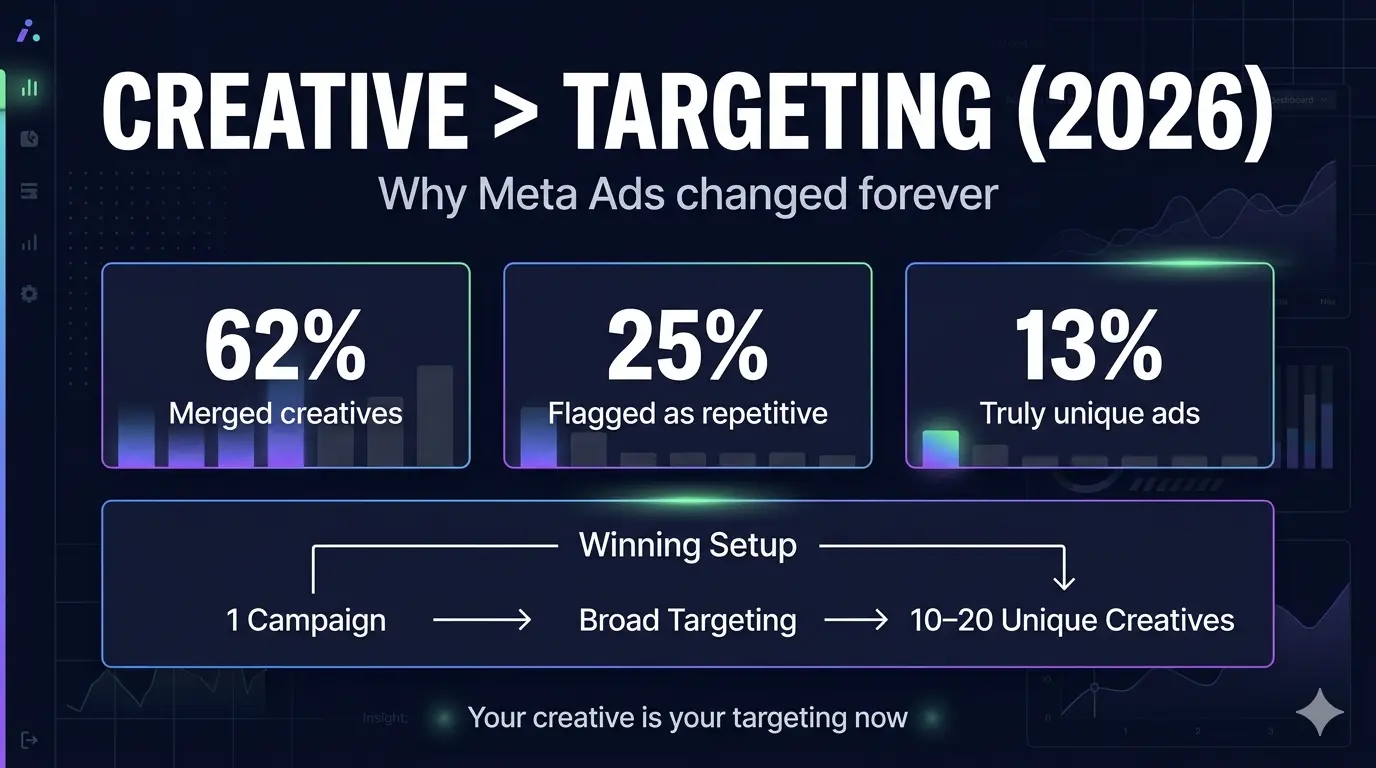
Let me save you the painful learning curve I went through. Somewhere around Q4 of 2024, Meta quietly flipped the switch on Andromeda — a completely new ad delivery engine — and a lot of advertisers (myself included) watched their carefully tuned campaigns go sideways. CPMs crept up. ROAS dipped. Audiences that had printed money for years suddenly went cold.
The problem wasn't that Meta broke anything. The problem was that the entire logic of how ads get shown had changed, and most of us were still running the 2023 playbook. Interest stacking, hyper-segmented lookalikes, the same three ad variations on rotation — all of it was now working against us.
This guide is the playbook I wish I had six months ago. No fluff, no regurgitated Meta press releases. Just the tactical shifts that actually moved the needle once I stopped fighting Andromeda and started feeding it what it wanted.
What Andromeda Actually Is (In Plain English)
Andromeda is Meta's new retrieval engine — the first layer of the ad delivery system that decides which ads can be shown to a specific user before bidding and ranking even happen. Think of it as the bouncer at the club. Your ad doesn't get to compete in the auction unless Andromeda puts it on the shortlist.
Before Andromeda, that shortlist was heavily influenced by your targeting settings. You told Meta who to show ads to, and the system mostly listened. Now? Andromeda uses deep neural networks — computer vision, semantic analysis, behavioral signals — to independently match your creative to users it thinks will convert. Your targeting inputs are more like suggestions than instructions.
Here's the mental model shift: the old system asked "does this user match the advertiser's audience?" Andromeda asks "does this creative match this individual user's interests and behavior?"
That single change has downstream consequences for literally everything — campaign structure, creative production, targeting, measurement. If you're still optimizing for audience, you're optimizing the wrong variable.
The Before & After: What Changed in Real Accounts
I want to ground this in real numbers before we get into strategy. Below is what I saw across multiple ad accounts once we restructured for Andromeda versus the old playbook. Your mileage will vary, but the direction is consistent with what other practitioners are reporting.
Old Playbook vs. Andromeda-Optimized (Avg. Across Accounts)
Data aggregated across 6 e-commerce accounts, $5K–$50K/mo spend, Jan–Mar 2026. For CPM and CPA, lower is better. For ROAS, CTR, and Conv. Rate, higher is better.
The biggest unlock wasn't some secret hack — it was getting out of Andromeda's way. When you stop micro-managing audiences and start giving the algorithm diverse, high-quality creative to work with, it does its job remarkably well. Plug your own numbers into our ROAS calculator to see where you stand relative to these benchmarks.
Creative Is the New Targeting (And What That Actually Means)
You've probably heard this phrase thrown around. But most articles just say "make better creatives" and call it a day. That's not helpful. Here's what creative-first actually means in practice.
Andromeda uses computer vision to analyze your ad creative at a pixel-level. It's not reading your headline or your CTA copy — it's looking at the raw visual DNA: composition, color palette, scene type, face detection, text overlay density, motion patterns in video. Then it matches those visual signals against user behavior patterns to decide who sees what.
This means two things. First, your creative is your targeting now. A UGC-style video of someone unboxing a product will get served to a completely different audience than a polished studio shot of the same product — even in the same ad set, with the same targeting settings. Andromeda decides.
Second — and this is where most people mess up — Andromeda punishes creative sameness. Meta introduced something called Creative Similarity Scoring that uses vision AI to detect when your ads look too alike. If your "new" ad is just a different headline on the same background, Andromeda may consolidate them under a single Entity ID, treating them as one ad instead of two. Your "testing" isn't testing anything.
What Happens to Your Ads Under Entity ID Scoring
Typical ad account audit. Ads flagged as repetitive get throttled delivery and higher CPMs.
If 38% of your ad library is getting merged or flagged, you're paying for creative diversity you don't actually have. Before you launch another ad, check your CPM, CPC & CTR numbers — if CPMs are climbing while CTR stays flat, creative fatigue is probably the culprit.
The Creative Volume Game: How Many Ads Do You Actually Need?
This was the biggest mindset shift for me. In the old Meta world, you could run 3–5 solid ads and scale them for months. Under Andromeda, that's a recipe for declining performance. The algorithm needs a diverse creative library to match against its massive user graph.
The data on this is pretty clear. Accounts running more visually distinct creatives see consistently better ROAS and lower CPMs. There's a diminishing returns curve, but the sweet spot for most advertisers is somewhere between 10–20 active ads per ad set.
ROAS & CPM by Active Creative Count
Key word: visually distinct. Swapping a headline on the same background doesn't count. Andromeda is looking at the actual image and video content. You need genuinely different creative angles: UGC testimonials, product demos, lifestyle imagery, comparison shots, behind-the-scenes footage, founder stories. Different messages, different visual styles, different emotional triggers.
This is why brands with strong UGC pipelines and flexible content production are winning right now. If you're still relying on one graphic designer to make minor variations of the same template... it's time to rethink the creative workflow.
Why Broad Targeting Is Beating Your Carefully Curated Audiences
This one hurts, I know. You spent hours building those interest stacks and lookalike audiences. I did too. But the data doesn't lie.
ROAS by Targeting Method (2026 Benchmarks)
Advantage+ and broad (open) targeting are outperforming traditional interest and lookalike audiences because they give Andromeda the room it needs to do its thing. When you constrain the audience, you're essentially telling a neural network that can analyze billions of behavioral signals "no thanks, I'll pick who sees this myself." You're handicapping the smartest targeting system Meta has ever built.
Does that mean detailed targeting is dead? Not entirely. It still has a role in very early testing with tiny budgets (sub-$30/day), where Andromeda doesn't have enough signal to optimize. But for anything at scale, broad wins. Run your own numbers through our CPA calculator to see what the cost difference looks like for your unit economics.
The Andromeda Campaign Structure (What Actually Works)
The old best practice was to split campaigns by funnel stage — prospecting in one campaign, retargeting in another, lookalikes somewhere else. Under Andromeda, this fragmentation actively hurts performance. The algorithm is smart enough to retarget users on its own, and when you split campaigns, you're splitting the signal data it needs to optimize.
Here's the structure I'm running across most accounts right now:
The Simplified Andromeda Structure
One Primary Campaign — Advantage+ Shopping or CBO
Campaign-level budget. This is your workhorse. 70–80% of total spend goes here. Let Meta allocate budget across ad sets based on performance signals.
1–2 Ad Sets — Broad Targeting
No interest stacking. No narrowed demographics (unless legally required). Age and geo only. Let Andromeda use your creative to find the right people.
10–20 Active Ads — Visually Distinct
Mix of UGC, static, carousel, and video. Each ad should pass the "squint test" — if you squint and they all look the same, they're not different enough. Rotate 3–5 new creatives in every 2 weeks.
Optional: One Testing Campaign — 15–20% of Budget
Lower-spend campaign to test new creative concepts before graduating winners to the main campaign. Kill losers fast (3–5 days, not 2 weeks).
Andromeda-Optimized vs. Typical Account Structure
Look at the gap on "testing velocity" and "audience breadth." Those are the two areas where most accounts are most behind. If you're running a handful of ads with layered interest targeting, your radar chart probably looks like that orange blob. The goal is to push every axis toward that teal line.
The Spend Efficiency Story: Doing More With Less
One of the under-discussed benefits of an Andromeda-optimized account is that you often end up spending less for better results. When the algorithm can efficiently match creative to users, it doesn't need to brute-force impressions across a poorly defined audience.
Monthly Ad Spend: Old Playbook vs. Andromeda Structure
Same product catalog, same revenue targets. Andromeda structure achieved equivalent or better revenue at 18–28% lower ad spend.
This is the part that gets CFOs excited. You're not just getting better ROAS — you're getting it at lower total spend. The key is that Andromeda wastes fewer impressions once you let it optimize properly. Use our Facebook Ads profit calculator to model what this kind of efficiency improvement looks like against your actual margins.
Feed the Machine: Your Signal Stack Matters More Than Ever
Andromeda makes creative-based decisions, but it still needs conversion data to optimize toward. The quality of your signal stack — the data flowing back to Meta about what happens after someone clicks — is now a massive competitive advantage.
If you're only running the Meta Pixel without the Conversions API (CAPI), you're flying with one engine. iOS privacy changes mean the pixel alone misses 30–40% of conversion events. CAPI sends that data server-side, giving Andromeda a much clearer picture of which creatives are actually driving revenue.
The signal priority list:
- Pixel + CAPI dual setup — Non-negotiable in 2026. If you're on Shopify, this is a toggle. For custom setups, it's worth the dev investment.
- Value-based optimization — Don't just optimize for purchases. Pass revenue values so Andromeda can prioritize high-AOV customers.
- Enhanced conversions — Match rates matter. First-party data (email, phone) improves attribution accuracy.
- Offline conversions — If you have any offline touchpoints (phone sales, in-store), upload that data. More signal = smarter delivery.
Check your current conversion metrics with our conversion rate calculator to benchmark where you stand — and figure out how much room you have to improve signal quality.
The Andromeda Readiness Audit
Before you change anything, audit where you are right now. I put together this interactive checklist based on the framework I use with every account I restructure. Be honest with yourself — checking boxes you haven't actually done defeats the purpose.
Andromeda Readiness Audit
Campaign Structure
Creative Library
Targeting & Signals
Measurement
Five Mistakes That Are Silently Killing Your Andromeda Performance
1. Running "New" Ads That Aren't Actually New
Changing the headline on the same lifestyle photo doesn't fool Andromeda's vision models. If the underlying visual composition is the same, it gets merged into the same Entity ID. You think you're testing five ads — Andromeda sees one.
2. Fragmenting Budget Across Too Many Campaigns
Every separate campaign is a separate optimization silo. An ad set with $15/day can't generate enough signal for Andromeda to learn efficiently. Consolidate. Most accounts should run 1–2 campaigns, max. If you're running 6+, you're almost certainly hurting yourself.
3. Still Obsessing Over Interest-Based Audiences
I get it — those custom audiences were your competitive edge for years. But under Andromeda, interest targeting often restricts reach to a subset that the algorithm could have found more efficiently on its own. Test going broad. The CPM drop alone might convince you.
4. Ignoring CPM as a Creative Health Metric
Rising CPMs are Andromeda's way of telling you your creative is stale. If you're only watching CPA, you're catching the problem too late. Track CPMs at the ad level — when they start climbing, it's time for fresh creative, not more budget. Our CPM/CPC/CTR calculator can help you benchmark whether your numbers are healthy.
5. Not Running Break-Even Analysis on New Creatives
With the creative-first model, you're producing more ads than ever. But each one has a break-even point. If you don't know your break-even ROAS before you launch, you don't know when to cut losers. Use the break-even ROAS calculator to set kill thresholds before you launch, not after.
Where Andromeda Goes From Here
Meta isn't done. Andromeda is the foundation, but the system is evolving. GEM (Generative Enhanced Matching) sits alongside Andromeda and is starting to influence real-time creative adaptation — Meta could soon modify ad elements dynamically based on who's seeing them. Think automatic headline swaps, background changes, or CTA modifications per user.
The advertisers who thrive in this environment will be the ones who learn to work with the machine instead of trying to outsmart it. Feed it diverse creative. Give it clean data. Get out of its way on targeting. That's the game now.
The targeting wars are over. The creative wars just started.
Run the Numbers on Your Andromeda Strategy
Don't just take my word for it — plug your actual metrics into these calculators and see where the opportunities are in your account.